


Our Approach
Knowing the steps isn’t the same as understanding the math.
A student can successfully follow a procedure without building the understanding needed to recognize when, why, or how to use it somewhere new.
Most math instruction starts with a question: How do we teach this?
At MIND, we start with a different one: How do students learn?
See why changing the question changes the learning. ↓
Start with Sense-Making.
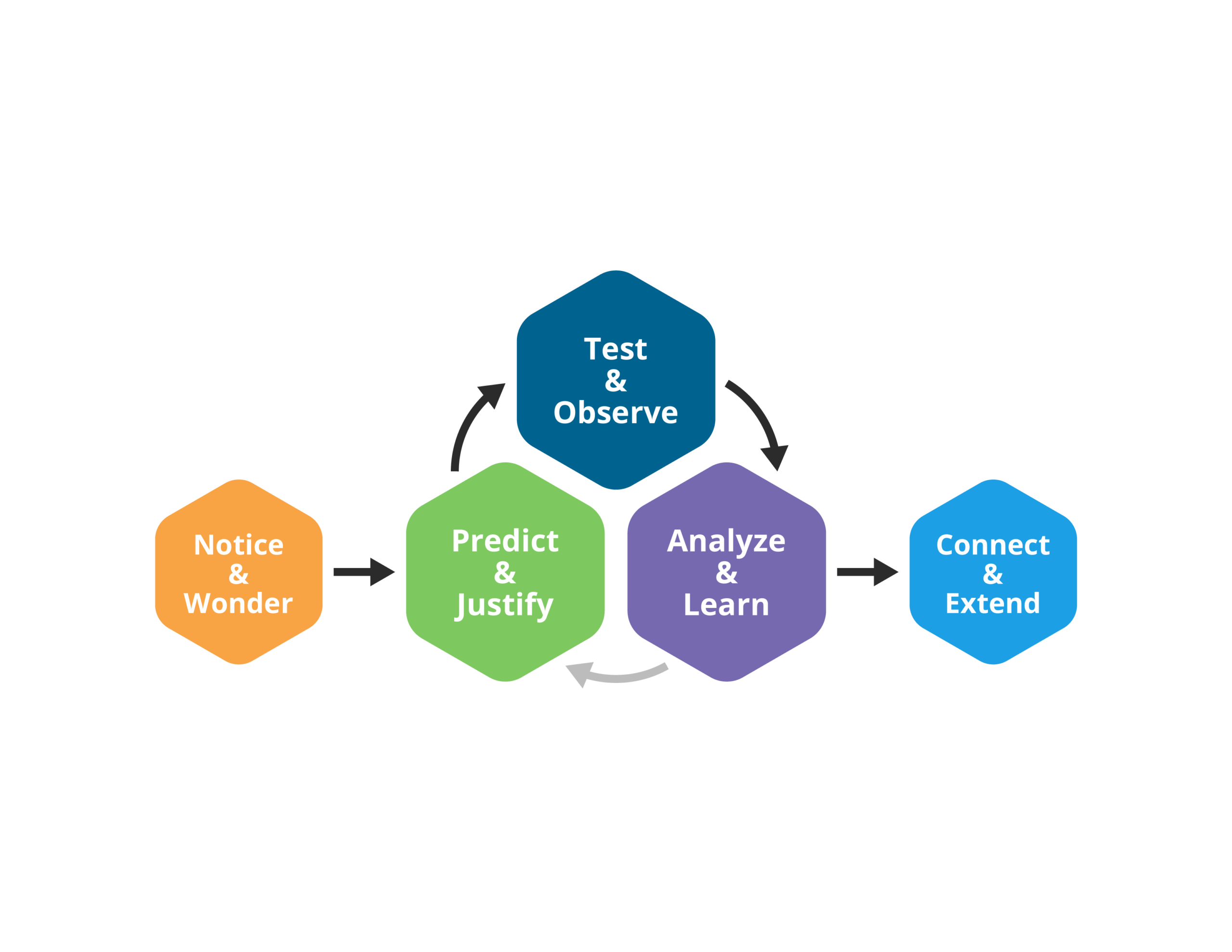
Students build understanding by seeing relationships, making predictions, testing ideas, and using what happens next to revise their thinking.
NOTICE & WONDER → PREDICT & REASON → TRY & OBSERVE → ANALYZE & LEARN → CONNECT & EXTEND
The destination is still rigorous mathematics—symbols, procedures, fluency, and mathematical language.
We simply change where the learning starts.
I’ve seen such a change in my students and their love for math.
Kelly McMullen, 4th Grade Teacher
When students make sense of the math, everything changes.
Students do more of the thinking.
They reason, test, revise, and make connections instead of only reproducing a demonstrated method.
Feedback becomes part of learning.
Students see what happened and use that information to decide what to try next.
Understanding travels.
When ideas are connected—not just memorized—students are better equipped when the problem looks different.

And the difference shows up in the results.
See how ST Math is helping schools and districts improve math achievement—and how MIND measures and validates its impact. For more on our real-world evidence, visit our Equity and Outcomes Page and explore our Research Validation and Methodology.
What if You Could Ensure Meaningful Math Learning for Every Student?
Download ‘I Think, I Try, I Learn’ and start making an impact today.
